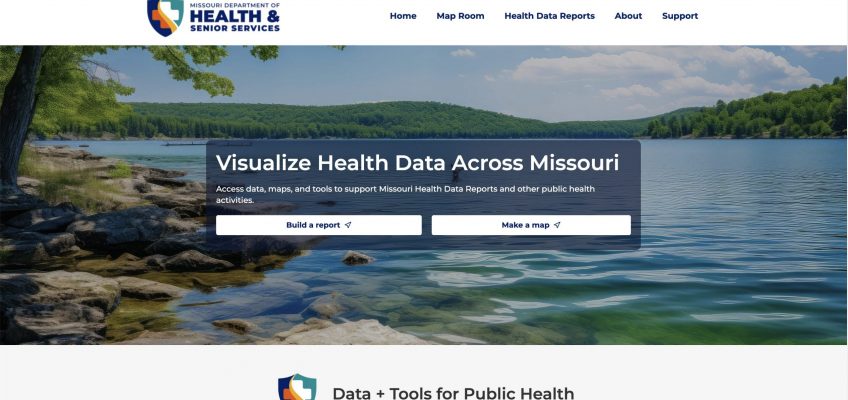
Missouri Department of Health and Senior Services Health Data portal

Missouri Health Data

This data portal provides access to results from the 2016 and 2022 Missouri County-Level Studies (CLS) and the Behavioral Risk Factor Surveillance System (BRFSS) data from 2014-2024. Data can be accessed through the reporting interface and the Map Room.
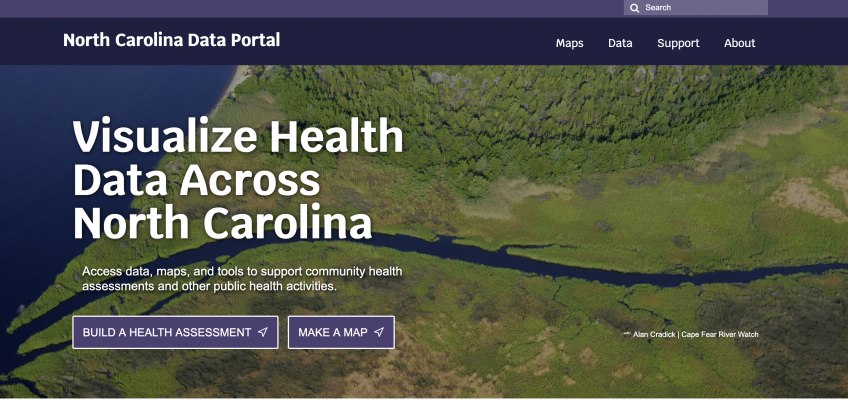
The NC Data Portal homepage. It features green fields and text that reads, "Visualize Health Across North Carolina."

North Carolina Data Portal

The North Carolina Data Portal provides data, maps, and tools to support community health assessments and other public health activities in North Carolina. The Hub includes data from both national secondary sources and the North Carolina Department of Health and Human Services. Data are available at state, county, and health department region levels.

One blue bar chart and two blue donut charts showing reportable diseases.

Local Health Department Communicable Disease Dashboards

CARES hosts and updates a series of local public health dashboards that provide citizens and the media with easy access to data on reportable diseases. Data are shown for more than 15 diseases in the county with benchmarks for previous years. CARES hosts dashboards for Andrew, Butler, Carter, Cass, Cooper, and Harrison counties in Missouri.

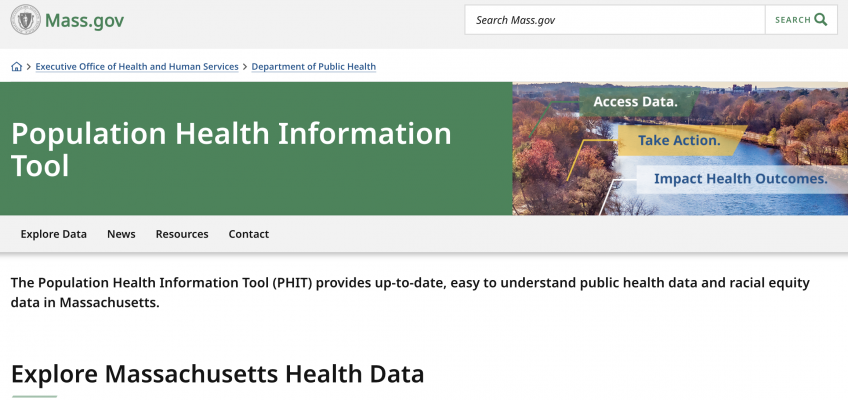
The Mass.gov Population Health Information Tool homepage.

Massachusetts Department of Health

The Massachusetts Population Health Information Tool (PHIT) is a suite of reporting and mapping platforms designed to help visitors find community and state-specific data quickly and easily. With access to over 100 indicators, the Community and State Reporting tools provide access to up-to-date data on social determinants of health, as well as health behaviors, health outcomes, and healthcare delivery. The platform also hosts a resource library and the Massachusetts Map Room.

A display of jams with paper labels

Boone County Food Insecurity

Boone County Food Coalition brings together local stakeholders to address food insecurity in the Boone County area. CARES provided data acquisition and mapping services to the Coalition.

PHATE Global Viewer logo

Public Health Assessment Engine (PHATE)

The Population Health Assessment Engine (PHATE) provides an investigative tool for physicians, hospitals, and clinics to visualize neighborhood characteristics and patient health risk factors in their service area. The tool integrates data from the American Board of Family Medicine’s (ABFM) Prime Registry database.

Trinity Health, Livonia MI logo

Trinity Health

The Trinity Health Data Hub supports a network of hospitals and their community benefit teams by providing easy access to core health outcomes and behaviors. The Hub hosts two reports – a custom Community Health Needs Assessment and a Vital Sign report. Data are available by hospital service area, aggregate areas, and system-wide.

Leonard Parker Pool Institute for Health logo

Leonard Parker Pool Institute for Health

The Leonard Parker Pool Institute for Health Hub, formerly the Lehigh Valley Community Hub, has been a CARES partner for 10+ years. The LPPIH Hub supports leaders working toward community change with a focus on cross-sector data-driven collaboration. The intent of the Hub is to encourage the sharing of data and the use of data to effect change throughout the lifespan of an initiative.

Advent Health logo

AdventHealth

The AdventHealth Hub was established in 2016 and used by the AdventHealth Community Benefit Team through 2021. The Hub was designed to serve the 44 faith-based AdventHealth hospitals across 10 states. AdventHealth used their custom Community Health Needs Assessment as a mechanism to better serve their communities, protect their not-for-profit status, and visibly convey their mission and faith-based values.

Adventist Health logo

Adventist Health Hub and Well-Being Dashboard

The Adventist Health Hub, first launched in 2017 and relaunched in 2020, provides hospitals in the Adventist Health system with: 1) a comprehensive community health needs assessment (CHNA); 2) custom calculations for hospital service areas; 3) a curated list of well-being aligned indicators; and 4) a system-level dashboard. The Hub is actively used by the Adventist Health Community Benefit team. The Hub also hosts the Adventist Health Priority Area Indicator Ranking (PAIR) tool. The PAIR tool helps hospitals prioritize the areas and people that need the most attention